
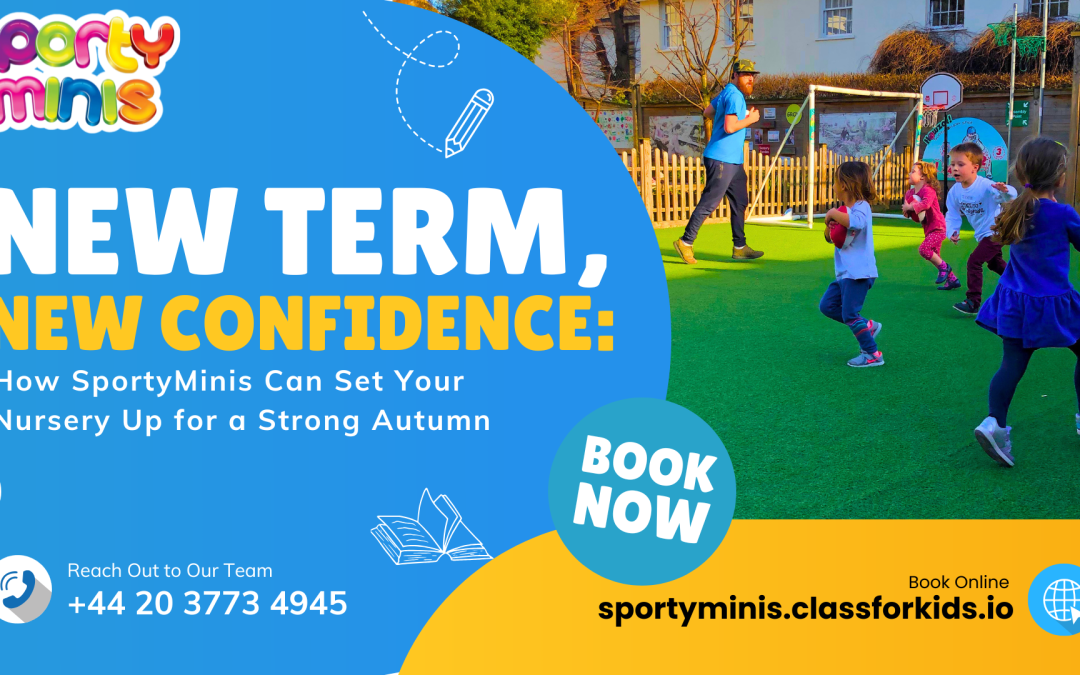
How SportyMinis Can Set Your Nursery Up for a Strong Autumn
Why the beginning of a new term is the perfect opportunity to make movement, confidence and physical development part of your nursery’s culture
September brings more than a new term.
It brings new routines, new friendships, new children settling into unfamiliar surroundings and new opportunities for learning.
For nursery managers and practitioners, it is also a natural point to look at the year ahead and ask an important question:
Are we giving children enough opportunities to become confident, capable and enthusiastic movers?
At SportyMinis, we believe the answer begins with purposeful physical education.
Early Years PE should not simply be a weekly opportunity for children to run around and use up some energy. When it is planned well, physical activity can support physical development, confidence, communication, relationships, independence and readiness for the next stage of learning.
That makes the Autumn term an ideal time to establish positive movement habits that can continue throughout the year.
The Autumn Term Is a Fresh Starting Point
The beginning of a new term is full of change.
Some children are starting nursery for the first time. Others are moving into a new room, meeting new practitioners or adjusting to different routines.
For many children, confidence takes time.
A child who is initially reluctant to join a group activity may need several weeks before they feel comfortable enough to participate. Another child may be physically confident but find turn-taking or listening to instructions challenging.
This is why the early weeks of the Autumn term matter.
They provide an opportunity to establish a culture where children understand that movement is something they can enjoy, explore and improve at their own pace.
At SportyMinis, we use purposeful, playful physical activity to help create that environment.
Rather than expecting every child to perform a skill perfectly, we focus on progression.
A child might begin by walking across a simple pathway.
Then they might balance.
Then they might jump.
Eventually, they may combine several movements into an obstacle course or game.
Each achievement gives the child another reason to think:
“I can do this.”
That feeling can be incredibly powerful.
Why Physical Activity Matters in the Early Years
The importance of movement during early childhood is well established.
The latest UK Chief Medical Officers’ guidance recommends that children aged 1 to 5 should aim for at least 180 minutes of physical activity each day, spread throughout the day. For preschool children aged 3 to 4, this should include at least 60 minutes of moderate-to-vigorous physical activity.
The guidance also highlights the wider benefits of physical activity, including supporting relationships and social skills, brain development and learning, movement and coordination, physical health and wellbeing.
This is important because PE does not exist separately from the rest of a child’s development.
When children move, they are learning about their bodies.
They are learning about space.
They are learning how to listen.
They are learning how to respond to instructions.
They are learning how to cooperate.
They are learning what it feels like to try something difficult and eventually succeed.
That is why we see early years physical education as an important part of a wider learning environment rather than an additional activity sitting outside the curriculum.
Building the Foundations Through the ABCs
At SportyMinis, our sessions place particular emphasis on the ABCs of movement:
Agility. Balance. Coordination.
These fundamental abilities underpin many of the movements children use every day.
Agility helps children change direction, control their bodies and respond to what is happening around them.
Balance helps children develop stability, body awareness and control.
Coordination helps them bring different movements together, whether that involves throwing and catching, kicking a ball or moving through an obstacle course.
These skills are developed through age-appropriate activities and our wider focus on Fundamental Movement Skills.
The aim is not to turn every child into a young athlete.
It is to give every child a strong physical foundation.
A child who develops confidence in these basic movements has more opportunities to participate successfully in playground games, outdoor play, school PE and everyday physical activity.
Making PE Part of the EYFS
The current EYFS statutory framework remains central to early years provision in England, with Physical Development, Personal, Social and Emotional Development, and Communication and Language forming the three prime areas of learning and development. The latest framework took effect from 1 September 2026.
This is where purposeful PE can become particularly valuable.
A well-planned movement session can support several developmental areas at the same time.
Physical Development
Children develop gross motor skills through running, jumping, hopping, balancing, throwing, catching and navigating different spaces.
They develop greater control over their movements and begin to understand what their bodies can do.
Personal, Social and Emotional Development
Physical activity creates natural opportunities for children to practise turn-taking, cooperation, perseverance and managing emotions.
A child who struggles when they cannot immediately complete an activity can learn to try again.
A child who wants to go first can learn to wait.
A child who is naturally confident can learn to encourage somebody else.
These are valuable developmental experiences.
Communication and Language
Movement creates a reason to listen and communicate.
Children may need to follow instructions such as moving over, under, around or through an obstacle.
They hear new vocabulary.
They describe what they are doing.
They communicate with their peers.
They listen to coaches and practitioners.
And when movement is connected with imaginative stories, children have another reason to talk, imagine and participate.
Making Movement Meaningful Through Play
Young children do not need a lecture about the importance of physical activity.
They need a reason to move.
That is why imagination is such an important part of the SportyMinis approach.
Instead of simply asking children to run around a set of cones, a session might turn the equipment into part of an adventure.
Children can become explorers.
Animals.
Pirates.
Superheroes.
Space travellers.
The story gives the movement a purpose.
Suddenly, jumping is not simply jumping.
They might be crossing a river.
Balancing might mean walking across a bridge.
Crawling might mean travelling through a secret tunnel.
Throwing might become a mission to deliver an object safely.
This approach can help make physical activity feel accessible to children who might not immediately see themselves as “sporty”.
And that matters.
We do not want children to believe that PE belongs only to the fastest runner or the child who can throw the furthest.
We want them to understand that movement belongs to everybody.
The Power of Small Wins
-Confidence rarely appears all at once.
-It grows through small experiences.
-A child balances for three seconds when they previously could not balance at all.
-They catch a ball for the first time.
-They complete an obstacle without help.
-They remember the instructions.
-They volunteer to go first.
-They encourage another child.
These moments might appear small to an adult.
For a young child, they can be significant.
At SportyMinis, celebrating these small achievements is an important part of creating positive associations with physical activity.
The objective is not simply to complete an activity.
It is to help children experience success.
When children repeatedly experience manageable challenges followed by achievement, they begin to develop greater confidence in their own abilities.
That confidence can influence how willing they are to approach other challenges too.
What Could an Autumn Term Look Like?
A progressive programme can allow children to build their skills gradually rather than expecting everything to happen immediately.
The First Few Weeks: Explore
The opening sessions can focus on familiarisation.
Children learn the routines.
They explore equipment.
They practise basic movements.
They learn how sessions begin and end.
Most importantly, they begin to feel comfortable participating.
The Middle of the Term: Develop
Once children understand the structure, activities can become progressively more challenging.
They might begin combining movements.
They might navigate more complex obstacle courses.
They might practise throwing and catching with greater control.
They might work with partners or small groups.
This is where children can begin to see the difference between what they could do at the start of term and what they can do now.
Later in the Term: Apply
As confidence grows, children can begin using their skills within games, challenges and imaginative scenarios.
Instead of practising balance in isolation, they might use balance as part of an adventure.
Instead of simply throwing a ball, they might work with a partner.
Instead of completing an obstacle independently, they might encourage a teammate.
Physical skills begin to become part of broader experiences.
Supporting Practitioners, Not Adding to Their Workload
One of the realities of early years education is that practitioners already have significant responsibilities.
Planning.
Observation.
Safeguarding.
Communication with families.
Supporting individual needs.
Creating engaging learning environments.
For that reason, introducing a specialist PE programme should not mean creating another substantial planning burden.
SportyMinis provides structured coach-led sessions designed specifically for young children.
Our coaches bring the equipment and lead the activities, allowing nursery practitioners to observe, participate where appropriate and identify how physical development connects with what children are doing elsewhere in the setting.
This can also provide practitioners with new ideas that can be carried into outdoor play and everyday routines.
A balance activity can become something children practise outside.
Movement vocabulary can appear during free play.
Throwing and catching can become part of an outdoor game.
Physical development becomes something that happens throughout the week rather than something that exists only during the designated PE session.
Giving Parents Something Meaningful to See
The start of a new term is also an opportunity to strengthen relationships with parents.
Families want to understand what their children are learning.
They want to know whether their child is developing.
And they want to see that activities have a meaningful purpose.
Physical development can sometimes be difficult for parents to visualise when compared with more familiar areas such as phonics, reading or early mathematics.
That is why making progress visible matters.
A child who was initially reluctant to participate can demonstrate new confidence.
A child who struggled to balance can show improved stability.
A child who avoided ball games can begin throwing and catching with enthusiasm.
These are tangible developmental changes that parents can understand.
At SportyMinis, we use age-appropriate recognition and progress information to help make children’s achievements visible to families.
The goal is not to turn early years development into a competition.
It is to celebrate progress.
Autumn Is About More Than Starting Again
A new term can sometimes feel like pressing reset. At SportyMinis, we see it differently.
It is an opportunity to build.
To establish routines.
To develop relationships.
To introduce new challenges.
To create positive experiences.
And to help children discover what their bodies are capable of doing.
The latest UK guidance is clear that every movement counts, and that physical activity in the early years contributes to health, development, relationships, learning and coordination.
For nurseries, that creates an important opportunity.
Physical education does not have to be complicated.
It does not need to be competitive.
And it certainly should not be something that children associate with being “good” or “bad” at sport.
It can simply be a joyful, purposeful opportunity to move, explore, learn and grow.
A Strong Autumn Can Shape the Whole Year
The habits established in September can continue throughout the academic year.
Children who learn that movement is enjoyable are more likely to seek it out.
Children who experience success are more willing to try again.
Children who learn to cooperate through games have more opportunities to practise those social skills elsewhere.
And children who develop physical confidence have stronger foundations from which to explore their environment.
That is ultimately what SportyMinis is trying to create.
Not simply better PE sessions.
Better experiences of movement.
Because when children learn to enjoy movement early, they are not simply learning how to run, jump, balance or catch.
They are learning that their bodies are capable.
They are learning that challenges can be overcome.
They are learning that trying matters.
And perhaps most importantly, they are learning that being active can be fun.
Make This Autumn a Term of Movement and Confidence
A new term gives every nursery the opportunity to think about how physical development fits into its wider vision for children.
At SportyMinis, we believe purposeful, playful and age-appropriate PE can become an important part of that vision.
Our aim is simple: to help children become active, confident and loving all things physical activity and sport, while supporting the wider development taking place within the nursery environment.
If you would like to explore bringing SportyMinis into your setting this Autumn, visit www.sportyminis.com and fill out the enquiry form on our website. Our team can then discuss your setting’s needs and how our early years PE programme could complement your provision.